No ride volume to protect
Chicago / independent driver intelligence
Driving Uber, Lyft, or both in Chicago?
Know the next two hours before you spend them.
At Least is an independent planning instrument for drivers who run Uber, Lyft, or both. It reads the city — not either platform — so you can decide whether to wait, switch, reposition, or call it.
No platform credentials
Street logic before shift
Drive scenePreviewing Chicago traffic stream
Your actual shift
You have two apps.
You still need one plan.
Uber and Lyft show their own worlds. Your shift happens across both — in the wait between requests, on the approach to the next opportunity, and on the trip home after the city changes.
Uber+Lyft≠At Least
01ORD / 00:45
You just dropped off at O’Hare.
Uber has a queue. Lyft has a queue. Both ask for your attention. At Least asks the driver question first: does the wait, the likely return, and the route back into Chicago make either queue worth your time?
CompareWait · next block · return
02Fulton / 21:30
One app is quiet after a West Loop drop.
Do you sit for a ping, turn toward River North, open the other app, or leave the corridor before the wave becomes obvious? The plan should make the trade-off visible without preferring either marketplace.
ChooseWait · switch · reposition
03McCormick / show close
The event is ending. Your day is not endless.
A release can be useful, but only if the approach and the next move still make sense. At Least can set a deadline so “skip it” and “go home” remain as valid as chasing the last possible request.
ProtectTime · distance · exit route
The non-driving part
A shift needs a
finish line.
At Least is not built to keep you driving. It is built to help you decide when a shift is worth starting, what you are working toward, and when the plan says the day is done.
See the driver briefing ›Do you know when to go home?
A quiet block is information. A real plan gives you a leave-by time instead of another open-ended wait.
Would you like a driving schedule?
Choose a realistic shift window, then see what the city may ask of that time before you give it away.
Want your life back from open-ended shifts?
Make time for the rest of your life by treating “enough for today” as a successful decision, not a missed ride.
AT LEAST / SHIFT PRINCIPLEDrive with a plan.
Leave with one too.
Leave with one too.
The independent difference
Their algorithm fills a marketplace.
Ours works for you.
One city plan
Not a heat map
No marketplace to fill
At Least sits outside Uber and Lyft. It can tell you to work the other app — or not work at all.
A floor, not a fantasy
Plans show what the engine expects at minimum, together with how much evidence sits behind the number.
Chicago-specific judgment
O’Hare timing, transit disruption, neighborhood waves, weather, traffic structure, and the time it takes to get home shape the city plan before your shift begins.
At Least / AI on your side
AI should show
its work.
At Least uses AI to turn a changing Chicago shift into one legible next decision. It does not tell you to chase an app. It compares the time, distance, likely payoff, and exit you are choosing — then shows you what is estimated, what is uncertain, and when to reassess.
01
It holds the whole decision together.
An airport queue, the approach, your remaining shift, operating cost, and a return route are not separate guesses. AI is used to keep the trade-off coherent before you spend the next hour.
02
It can explain why the answer changed.
A plan can become less attractive as time passes. At Least can surface the changing assumption, a leave-by time, and a quieter alternative instead of pretending the original suggestion is still right.
What drivers are saying
“We are effectively guinea pigs for a system designed to break us.”
This is a driver’s public view of platform AI, not a claim by At Least. The point is not more hype. It is an AI tool whose recommendation is visible, challengeable, and centered on the driver’s time.
Read the public r/uberdrivers discussion ↗AT LEAST / NOWAI BRIEF
Estimated planning rate$31.20/ HR
At Least floor$24.77 / hr
Next decisionDon’t join the long queue. Recheck at 23:15.
What the rate weighs
Illustrative planning readout. Rates are estimates, not a promise of earnings or rides.Expected trip value · time to reach it · wait and trip time · vehicle cost · what the next move leaves you with.
Lyft’s public AI planning feature is designed around a single platform’s airport and event guidance. At Least starts outside that marketplace: “is this next block worth your time?”
A useful difference
A platform assistant has a platform.
At Least has a driver.
Every recommendation has an objective. At Least starts with yours: make the next two hours worth your time, across the apps you choose to run.
Decision framePlatform-owned assistantAt Least
Starting question
How can this marketplace respond?
Is this next block worth your time?
Scope
One platform’s view of the shift.
One independent view of Chicago.
Useful answer
Where that platform needs activity.
Where to go, what to skip, and when to leave.
When conditions are thin
Stay inside the platform’s frame.
Show the uncertainty — and make “go home” a valid answer.
CHI / SHIFT MAPNOT A HEAT MAP
ORDO’Hare
Wrigleyvillenorth wave
Fultonlate exits
Loopturnover
McCormickevent release
MDWairport choice
Decision, not destination.
A Chicago plan weighs the next move against the time it takes to leave it.
Chicago in motion
Not “where is busy?”
What happens next?
A good shift in Chicago is rarely one hot neighborhood. It is a chain of choices: whether an O’Hare wait makes sense after midnight, whether Fulton Market is about to empty into River North, whether a McCormick Place release is worth the approach, and whether the trip home erases the upside.
O’Hare · 01:00
Queue, or keep moving?
Compare a possible airport wait with the next useful block and the cost of getting back into the city.
Fulton Market → River North · late evening
Leave before the wave is obvious.
Plan the approach around a likely release window instead of joining every other driver after it starts.
McCormick Place · show close
Know the exit has a clock.
Use a time-bound opportunity, not a permanent “best zone,” then carry its next-move consequence forward.
Chicago locations illustrate the planning logic. They are not standing or staging instructions, and no earnings outcome is promised.
The driver’s briefing
One move. One floor. One deadline.
The Now screen is built for a stoplight, not a spreadsheet. It gives the next best move, why the city is pointing there, and the moment to stop waiting.
A signal before the shift
A reason to leave
Location stays local
Next move
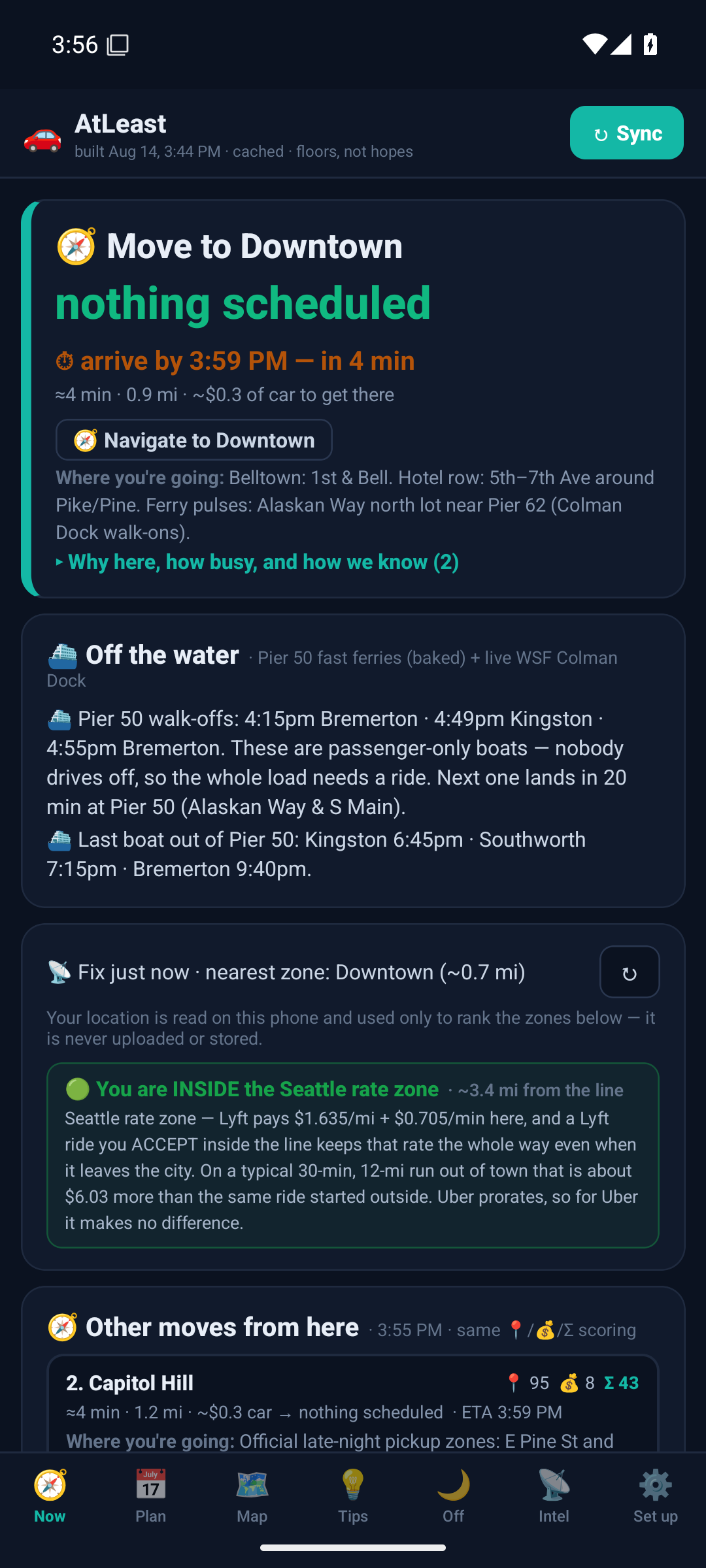
Independent input — The information is yours. The decision stays yours.
Chicago is not one market
More than a heat map.
Chicago runs on events, airport timing, transit changes, weather, traffic structure, and the time it takes to get home. At Least turns those moving pieces into a plan, then learns your own driving pattern without tracking your routes.
Zones and opportunity windows
Useful on day one, personal every week
Chicago / research beta / status: open
Chicago drivers: be early, not first in line.
The Chicago research beta is for drivers who want to pressure-test a neutral planning tool against the way the city actually works.
Read the Chicago driver guide ›First market
Driver-tested
Plan ahead